

Beijing Zhenchong Engineering Machinery | Methods for Liquefaction Ground Treatment
Published Time:
2021-04-15
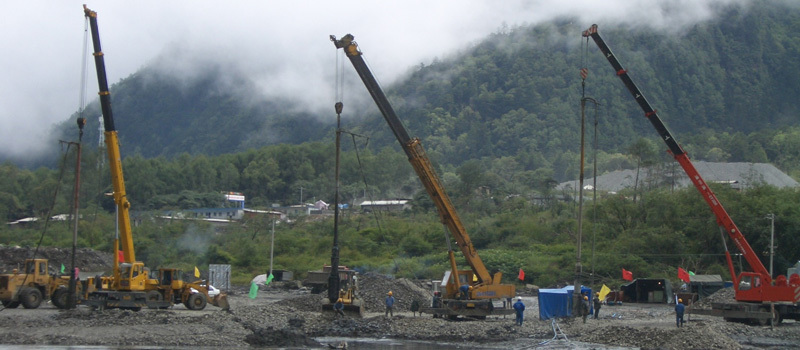
Loose sand and silty soil become saturated under the action of groundwater. If the soil is subjected to vibration in this case, it will tend to become denser. This tendency towards compaction causes a sudden increase in pore water pressure. During this brief vibration, the rapidly rising pore water pressure does not have time to dissipate, causing a decrease in the pressure originally transmitted by the contact points between soil particles (effective pressure). When the effective pressure completely disappears, the soil layer will completely lose its shear strength and bearing capacity, becoming like a liquid; this is the phenomenon of liquefaction of the foundation. Therefore, liquefaction requires loose sand and silty soil, along with vibration and water. The main factors affecting liquefaction include grain gradation, permeability, relative density, soil layer depth, groundwater level, earthquake intensity, and earthquake duration. Liquefaction of the foundation can manifest as sand boils and water eruptions, embankment collapse, ground cracking, and uneven settlement on the surface, causing great harm to buildings above. Therefore, liquefaction sites should be prioritized for foundation treatment to consolidate the soil within a certain range around the building. Specific methods can be selected based on the characteristics of the site and building.
1. Vibroflotation
Vibroflotation originated in Germany in the 1930s and has since been adopted by many countries. It is very effective in improving the liquefaction resistance of saturated silty and fine sandy soils, increasing the Dr of sandy soil to 0.80. Vibroflotation has displacement, compaction, and vibratory compaction effects on different types of soil layers. For cohesive soils, it mainly plays a displacement role. For medium-fine sand and silty soil, in addition to the displacement effect, there are also compaction and densification effects. During construction in the above soils, gravel (pebbles, etc.) or backfill material must be added to the vibroflotation holes to form dense vibroflotation piles, while the soil between the piles is subjected to varying degrees of compaction and densification. At the same time, the backfill material forms a gravel well point, which can densify the sand layer and quickly drain the water, dissipating the pore water pressure developed in the sand layer, thereby better eliminating soil liquefaction. The main equipment for vibroflotation is a special vibrator with a high-pressure water jet at the front, causing the sand and soil near the nozzle to liquefy rapidly. The vibrator sinks into the sand layer by its own weight and vibration, squeezing the floating sand to the surroundings and compacting it during the sinking process. After the vibrator sinks to the design depth, gravel, pebbles, and crushed stone are backfilled into the hole, and then the vibrator is gradually lifted to compact the fill and the surrounding sand layer. Vibroflotation compaction gravel pile method, also known as stone column method, refers to the formation of large-diameter, dense piles of sand or gravel by vibration, impact, or water jetting to form holes in weak foundations and then compacting the sand or gravel into the formed holes. The treatment depth should not be less than 4m and should pass through the liquefied soil layer.
2. Dynamic Compaction
Dynamic compaction, also known as dynamic consolidation or dynamic compaction, is a method that repeatedly raises a rammer (generally weighing 10-40t) to a certain height and allows it to freely fall (drop distance is generally 10-40m), giving the foundation impact and vibration energy to improve the bearing capacity and reduce the compressibility of the foundation, improving its performance.
3. Diaphragm Wall Encasement
Encasing the potentially liquefiable sand layer around the building with diaphragm walls, combined with the sealing effect of dense backfill soil, can greatly reduce the possibility of sand liquefaction in the foundation.
4. Replacement and Compaction of Soil and Increased Weight of Non-Liquefiable Cover Soil
When the thickness of liquefiable soil on the surface or under the foundation is 3-5m, replacement and compaction can be used, which is relatively economical and practical. When full replacement is difficult, the thickness of the compacted fill soil can be checked to see if the effective pressure on the top surface of the saturated sand layer is greater than the critical pressure that may cause liquefaction. If the weight of the compacted fill soil is sufficient, then full replacement may not be necessary.
The above measures for treating foundation liquefaction all eliminate liquefaction by compacting the soil and accelerating drainage. Some foundation treatment methods cannot eliminate liquefaction, such as rigid pile composite foundations. Practice shows that vibroflotation is one of the most effective methods for treating liquefied foundations and has been widely used.
Related News
Follow us

Tel:+86-18201288462
Email:lsn@bjvibro.com
Address: Songzhuang Cultural Park, Beijing sub-center - Xiaobao Art District